Mithra
Lord of the covenant and the broad pastures, who rides before the sun with a thousand ears and ten thousand eyes. No oath escapes him; no liar survives his gaze.
Before history there was a wager, and the wager set time itself in motion. What follows is the deep story the Order rehearses by firelight — half cosmology, half memory of Iran.
In the beginning were two: Ahura Mazda in the endless light above, all-knowing; and Angra Mainyu — Ahriman — in the abyss below, ignorant and destroying. Between them, emptiness. Mazda, foreseeing the war, proposed a fixed term of twelve thousand years in which good and evil would be tried in the open, knowing that bounded time would exhaust the Lie.
For three thousand years Mazda fashioned the world in spirit, perfect and motionless. Then he uttered the Ahuna Vairya, and at that one sound Ahriman was struck senseless for three thousand years more. In that respite the material world was made: the sky of stone, the waters, the earth, the plant, the Primal Bull, and Gayōmart the first man, bright as the sun.
Then Ahriman woke and broke in — fouling water with salt, earth with desert, fire with smoke. He slew the Bull and the Man. But from the dying Bull sprang all beasts and grain; and from the seed of Gayōmart, purified forty years in the earth, grew the rhubarb-plant that became Mašya and Mašyāna, the first human pair. The war was joined inside creation, and it is not yet over. We live in the last three thousand years.
Older than the long story of the twelve thousand years is the doctrine the Prophet himself sang in the Gāthās — and it is not a tale but a question put to every soul. In the thirtieth hāiti of the Yasna, Zarathushtra names the two primal Mainyus, the twin Spirits, who at the first dawn declared themselves: Spənta Mainyu, the Bounteous, and Angra Mainyu, the Hostile. “In the beginning,” he sings, “these two declared themselves — the better and the bad, in thought and word and deed; and between them the wise chose rightly, not so the foolish.”
The one chose Aša — Truth, the right order of the world. The other chose Druj — the Lie, the disorder that gnaws at it. Here is the heart of the whole faith: evil is not a power equal and eternal to good, nor a flaw in the maker, but a choice — the first of all choices, and one re-made in every heart that wakes. “To this life chose he Truth; to that one, the worst existence chose the Lie.” Even the daēvas, the old bright gods, are not demons by their nature but by their election: they chose wrongly, and so became devils.
This is why the Order calls itself an order of choosing, not of fate. The cosmic war of stone and seed is only the long working-out of a verdict each of us also passes, alone, in the quiet before a deed. To think well, to speak true, to act rightly is not obedience — it is to side, freshly, with the Bounteous Spirit, and to lay one more grain against the Lie.
Beneath Mazda and the Seven stand the yazatas, “those worthy of worship” — the bright powers who guard the world and answer the faithful.
Lord of the covenant and the broad pastures, who rides before the sun with a thousand ears and ten thousand eyes. No oath escapes him; no liar survives his gaze.
The undefiled waters, the heavenly river — strength, fertility, and cleansing. Kings poured libations to her for victory; her star has eight rays.
The star Sirius, bringer of rain, who each year does battle with the demon of drought, Apaoša, in the form of a white stallion above the cosmic sea.
Victory itself, “the smasher of resistance,” who appears in ten forms — wind, bull, horse, boar, and the swift bird of prey whose feather wards off all harm.
Obedience and the heard prayer — the watcher who never sleeps, who guards the soul through the perilous three nights after death and conducts it to the Bridge.
Rašnu the just, who holds the golden scales at the Bridge of the Separator; and Aši, fortune and reward, who follows the righteous like a shadow of gold.
Two of these powers the Sasanians cut into the living rock of Taq-e Bostan, standing them beside the king so that none could mistake from whom his crown descended — Mithra of the covenant, and Anāhitā of the waters of sovereignty.
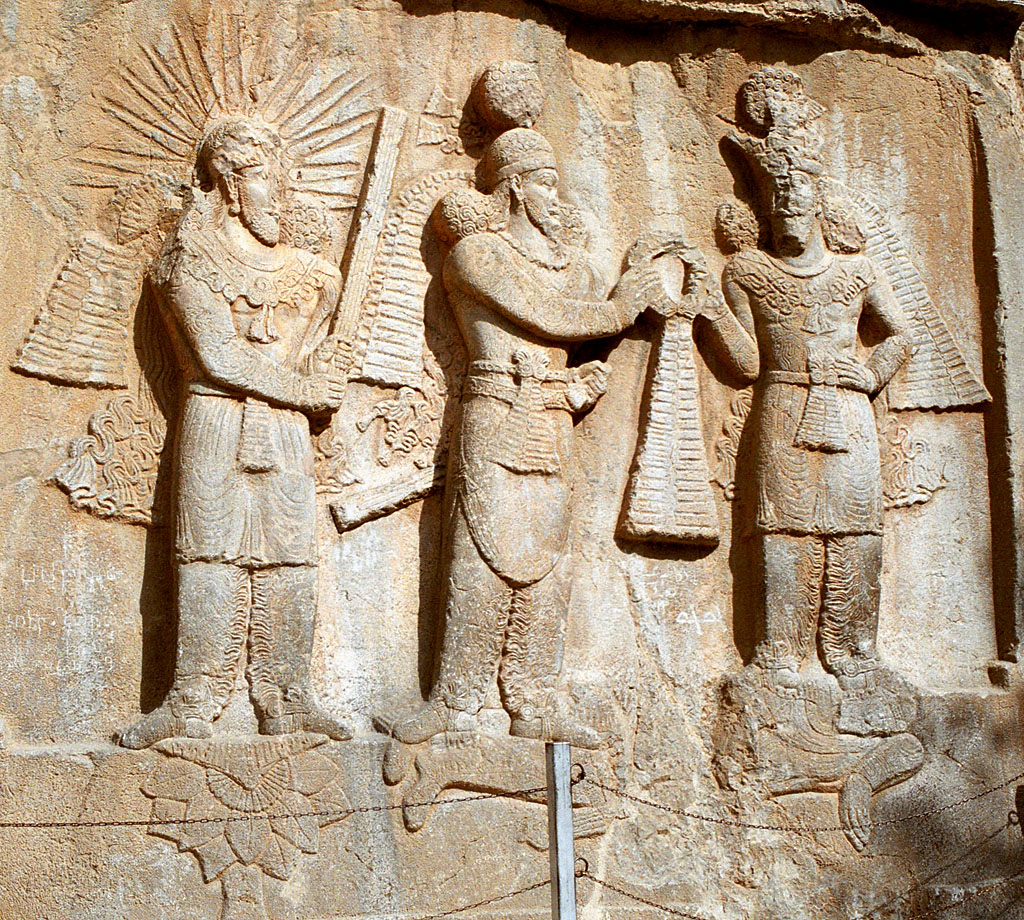
Ardashir II receives the ring of rule between Ahura Mazda and the fallen Roman emperor underfoot; behind him stands Mithra, radiate-haloed upon a lotus, the barsom bound in his hands — the unsleeping witness to every oath of kingship.
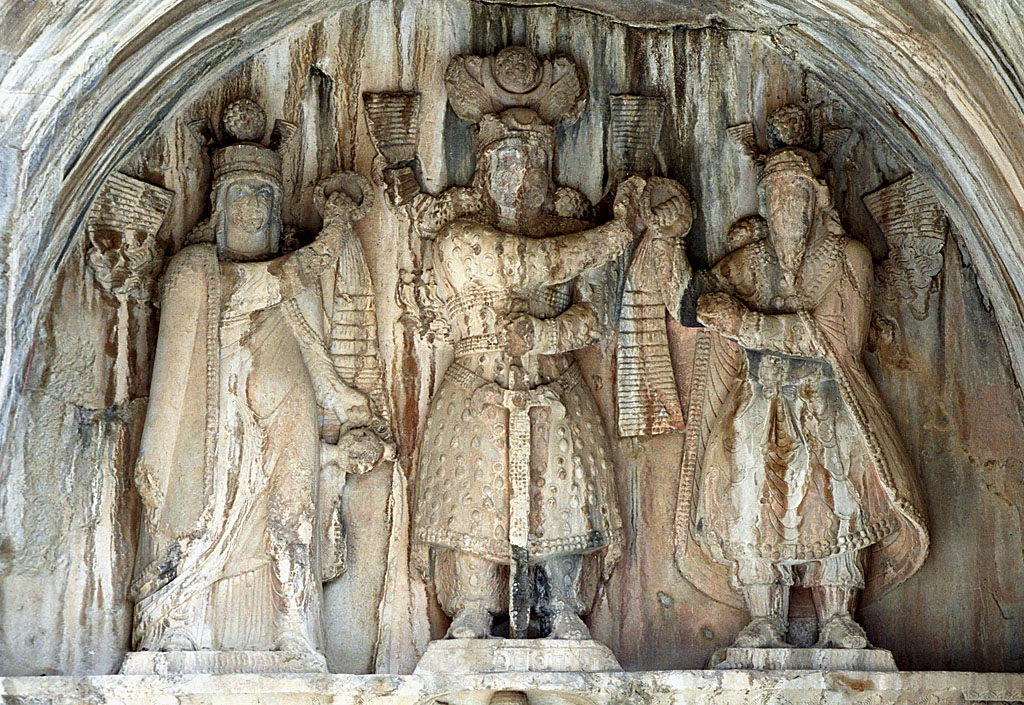
In the upper register of the grotto the king stands crowned between Ahura Mazda and Arədvī Sūrā Anāhitā, who tips her vessel — the undefiled waters from which legitimate rule, like all life, must flow.
The Bundahišn maps the night as a battlefield no less than the earth. Four star-chieftains are set over the four quarters of the world to guard its gates against the dark; the seven of the north stand chained about the Peg of Heaven, the still nail around which the whole sky is drawn. The wandering planets, the priests taught, are Ahriman's spies loosed among the fixed and faithful stars. Touch a great star to learn its watch.
The four quarters and their chieftains · the Big Dipper chained in the north · select a star, or arrow to it.
The myth becomes the Šāhnāmé, Ferdowsī’s Book of Kings, where the cosmic war wears human faces:
Two relics of the rising against Żahhāk: the standard that summoned a people, and the river one man dared to cross to reach the tyrant.

When Kāva lost his sons to the serpent-king's hunger he lashed his blacksmith's leather apron to a spear and raised it in the street. That rough flag became the Derafš-e Kāviānī, jewelled by later kings into the standard of Iran itself — a worker's grief made the ensign of an empire, carried until the Arab conquest tore it down.
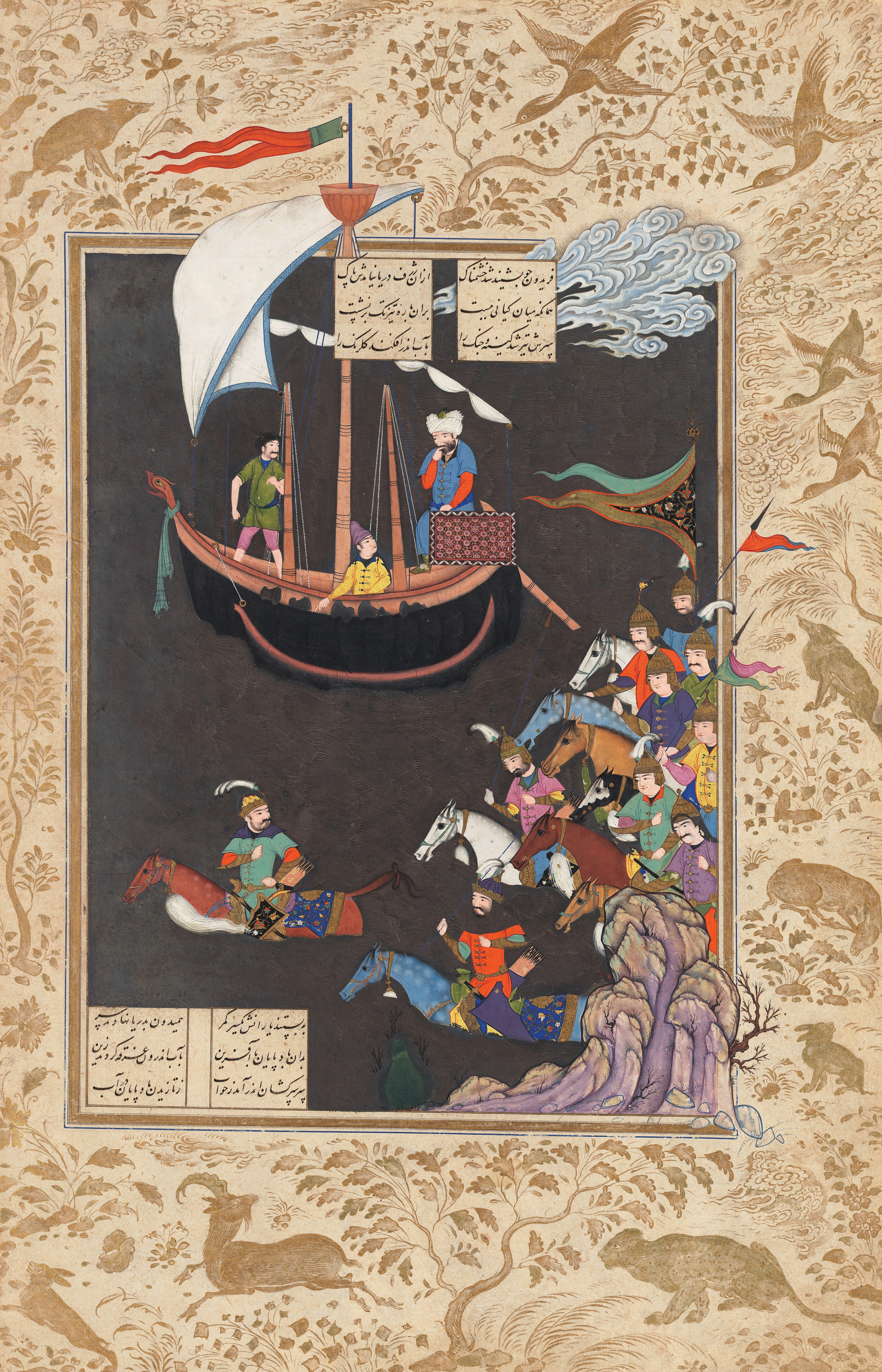
Marching on the usurper, Fereydūn comes to the Tigris and asks the ferryman for passage; refused, he spurs his horse into the flood and crosses by his own will. Beyond the far bank waits the tyrant whom he will not kill but bind — chained living beneath Mount Damāvand until the end of days.
What the war decides for the world, death decides for the single soul — and the faith maps that crossing in close detail. For three days and nights, the Hādōxt Nask tells, the urvan, the soul, lingers by the head of its body, reciting the verse uštā ahmāi — “happiness to him” — and tasting already the savour of what it has earned. At the dawn of the fourth day it rises and goes to the Činvat Pərətu, the Bridge of the Separator, that spans the abyss between the worlds.
There the deeds are weighed. Rašnu the just holds the golden scales, and Mithra and Sraoša stand as judges, for no lie crosses here. And there the soul meets its own daēnā — its conscience, the sum of all it thought and said and did, made flesh and walking toward it. To the righteous she comes as a maiden of fifteen years, radiant, fragrant, lovelier than any living woman; “I am thine own conscience,” she says, “thou hast made me lovely by thy good thoughts and words and deeds.” To the wicked she comes as a withered hag, foul-breathed and terrible, born of his own corruption — for each soul is met by exactly what it made.
Then the bridge itself gives judgement. For the just it broadens to the width of nine spears or nine lengths of a road, and the maiden leads them up across it to the House of Song, the lights without beginning. For the wicked it turns edgewise, sharp as a razor; they totter, and the hag drags them down, and the bridge casts them into the House of the Lie — not forever, the Order holds, but until the river of molten metal at the world's end washes even hell clean and folds all souls back into the light.
From the seed of Zarathushtra, preserved in a hidden lake, a virgin will conceive the final Saošyant, the World-Healer. He will raise the dead, lead the last battle, and pour the molten metal that purifies all souls — a river of fire that the righteous feel as warm milk. Then comes Frašōkərəti: the world remade, deathless and shining, and time folded back into eternity. The Order keeps the embers against that dawn.
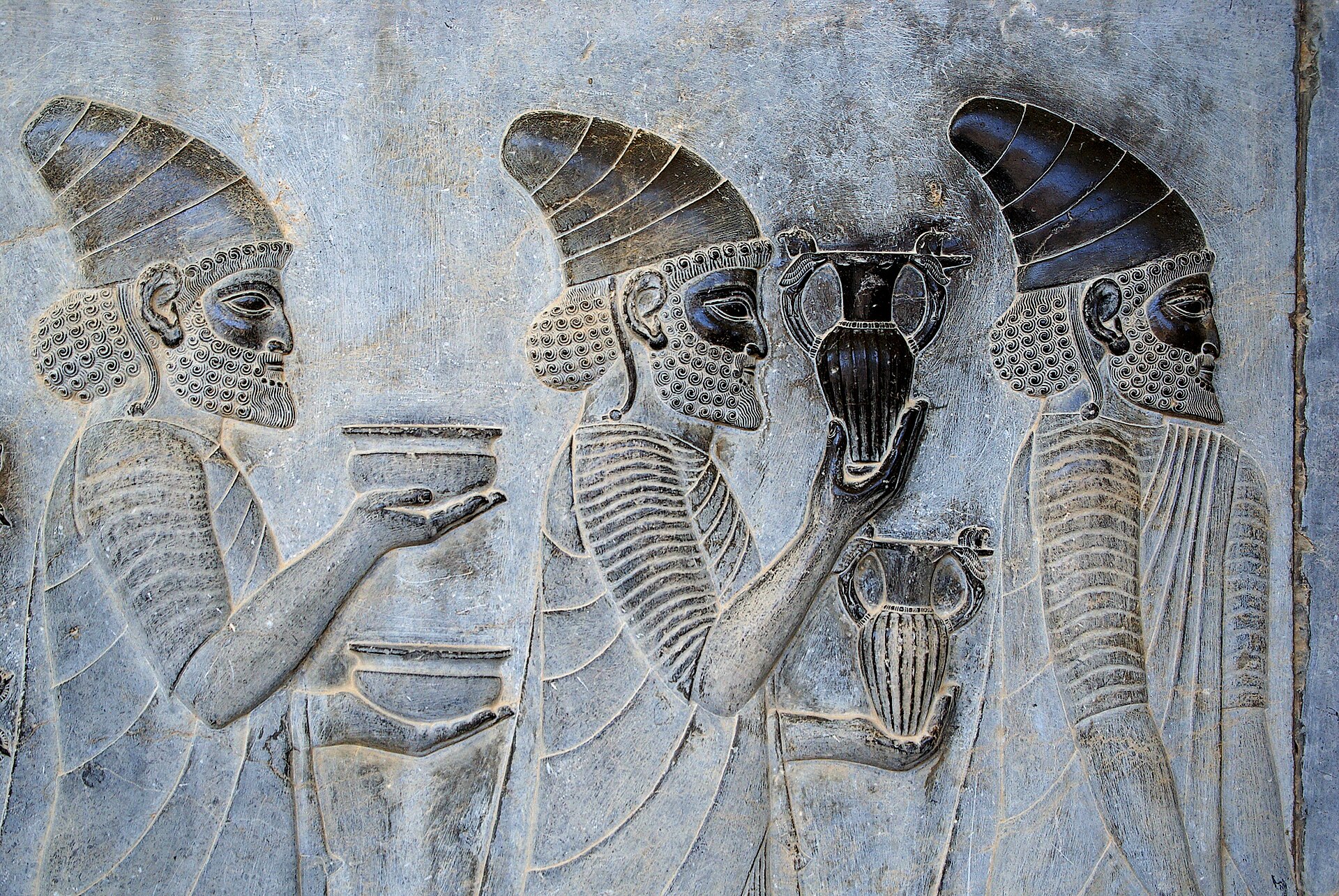
On the Apadana stair the nations climb forever toward the king at Nowruz — the myth carved into limestone, still walking after twenty-five centuries.
The Bundahišn counts the world in seven makings — sky, water, earth, plant, animal, man, and fire — each set in the keeping of one of the Aməša Spəntas, the Bounteous Immortals. Six of them the faithful still celebrate in turn, at the six seasonal feasts called the Gāhānbārs, five days apiece; the seventh, fire, is not given a season, for it pervades all the rest and is honoured in every flame at every hour.
Mid-spring. The first making — the sky of rock crystal that closed round the world like a shell, the rampart against the dark. Guarded by Xšaθra, the Kingdom.
Midsummer. The gathered waters, the heavenly river Arədvī, lifeblood of the world. Guarded by Haurvatāt, Wholeness — the health that is wetness and flow.
The bringing-in of the corn. The earth spread wide and patient under all that stands on it. Guarded by Spəntā Ārmaiti, holy Devotion, who is the ground herself.
The homecoming, when the herds return from pasture. The green making — every grass and grain and the white Hōm. Guarded by Amərətāt, Immortality, the undying life of the seed.
Midwinter. The fifth making — the beasts, descended from the Primal Bull whose death sowed the species. Guarded by Vohu Manah, the Good Mind, shepherd of the gentle herd.
The last nights of the year, before Nowruz, when the Fravašis of the dead come home. The sixth making — humankind, descended from Gayōmart. The feast that gathers all the others up.
To keep a Gāhānbār is to stand watch over one limb of creation and to share bread freely while you do it — rich and poor at one cloth, for the world was made whole and is mended only together.
The wheel of the year, still turned in Yazd and wherever the faithful remain.
The spring equinox, the rebirth of the world and the feast of Rapithwin, the spirit of noon, returning from underground. The oldest festival kept by humankind.
Midwinter fire-feast, fifty days and nights before Nowruz, marking the discovery of fire by King Hušang. Great bonfires push back the cold and the dark.
The autumn feast of Mithra — covenants, harvest, and gratitude, the second of the year’s great days, balancing Nowruz across the wheel.
The longest night, the birth-night of the unconquered sun, kept awake with fire, fruit, and poetry until the dark is beaten and the light is born again.
Between the yazatas above and the Lie below moves a third host — birds that nest in the Tree of All Seeds, serpents that wear crowns, guardians half man and half beast. The Order keeps their names as it keeps embers: 𐬯𐬌𐬨𐬎𐬭𐬖 — for a name remembered is a door kept open.
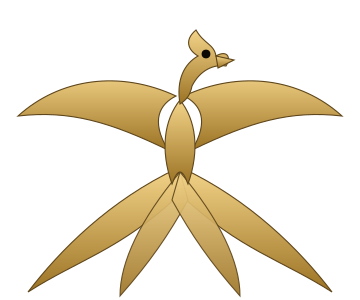
Avestan Saēna mərəγa, the great falcon-bird who roosts in the Tree of All Seeds amid the world-sea Vourukaša. When she rises, the tree shakes and a thousand kinds of seed scatter on the wind. She raised the white-haired child Zāl in her nest on Alborz, and her healing feather still answers fire.
The bird of fortune, who never alights and casts no harm — she lives on bone and air, and slays nothing living. Whomever her shadow crosses is marked for kingship; the masters of Persepolis carved her double head into the capitals that bore the roof of empire.
Dog-bodied, eagle-winged, the gleaner who waits beneath the Saēna tree. The Bundahišn tells how he gathers the seeds the Sīmurgh scatters and bears them to the rain-star Tištrya, so that every shower seeds the earth anew. He patrols the summit of Alborz against the enemies of Iran.
The lion-eagle, griffin of the plateau since Elamite days — body of the king of beasts, head and wings of the king of birds. Set at thresholds and treasuries, he guards what is hidden; the unfinished gate of Persepolis still bears his double watch in stone.
The dragon. In Iran a serpent that escapes the sword grows for centuries in secret until it darkens a valley and drinks rivers dry. To face one is the trial of trials: Rostam's third labour, Bahrām Gūr's wager — the hero descends into the smoke, or Iran does.
The storm-serpent of three mouths, three heads, and six eyes, mightiest drug that Angra Mainyu loosed upon the world — so the Avesta names him in the hymns. In the Šāhnāmé he wears a man's shape as Żahhāk, serpent-shouldered; Fereydūn chained him under Damāvand, where he waits for the last days.
The daēvas who chose the Lie, grown monstrous — horned giants of Mazandaran, sorcerers of fog and stone who relish the flesh of men. Rostam's seventh labour was to enter their dark and slay the White Dīv, and with its blood wash the blindness from a king's eyes.
The peri — winged spirits of unbearable beauty. The Avesta knew them as pairikā, witch-lights serving drought and the dark; the centuries gentled them into exiles shut out of paradise, working off their old allegiance one kindness at a time. Trust them at your peril, and at your profit.
The unicorn of the steppe and the scrublands, one-horned, irascible, master of every beast that crosses its plain. No hunter takes it by force; only the voice of the ringdove can still its rage — proof, the sages say, that even fury keeps one door open to gentleness.
The bull-man king, human to the waist and ox below, who sits at the shore of the world-sea in the pure land. The Bundahišn says he performs the yasna there forever, pouring hallowed water into the deep so that the noxious creatures of Ahriman may not breed in it.
The Kara fish — ten of them circle the white Hōm, the Tree of Life in Vourukaša, day and night without sleep. The Bundahišn grants them the sharpest sight in creation: they feel a ripple thinner than a hair, and the lizard Ahriman sent against the tree has never passed them.
Old Persian martya-khvāra, "man-eater" — a name the Greeks carried west from the Persian court as mantichora. Lion-bodied, human-faced, triple rows of teeth, a scorpion's tail that casts its stings like arrows. Of all the bestiary, the only one whose hunger is purely for us.
Painters of Tabriz, Shiraz, and Isfahan gave the bestiary its faces. These folios, centuries old and freely given, are kept here as the Order keeps all true relics — with their provenance.
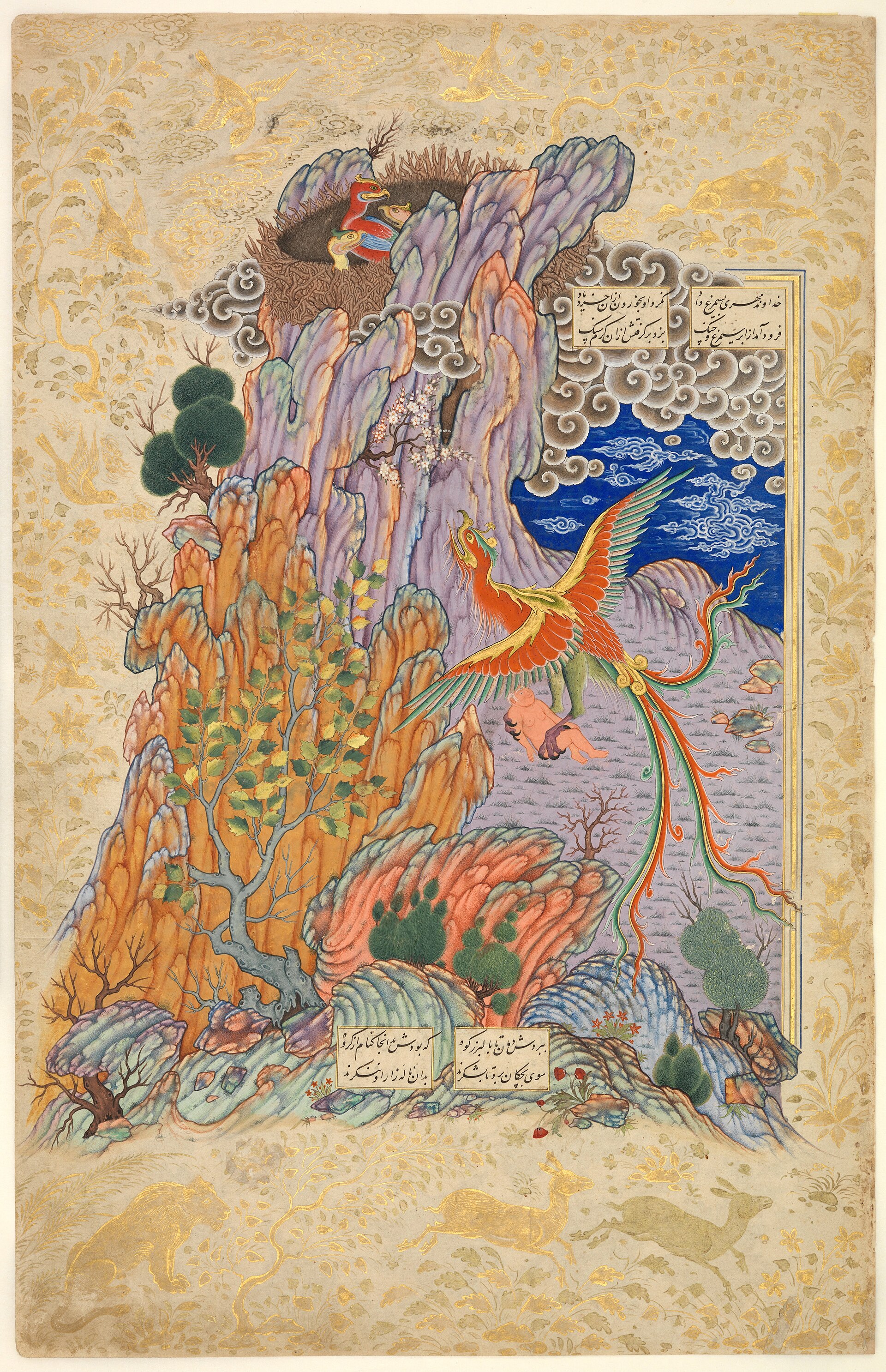
The great bird bears the abandoned white-haired child to her nest on Alborz. Attributed to Sadiqi Beg, Isfahan.
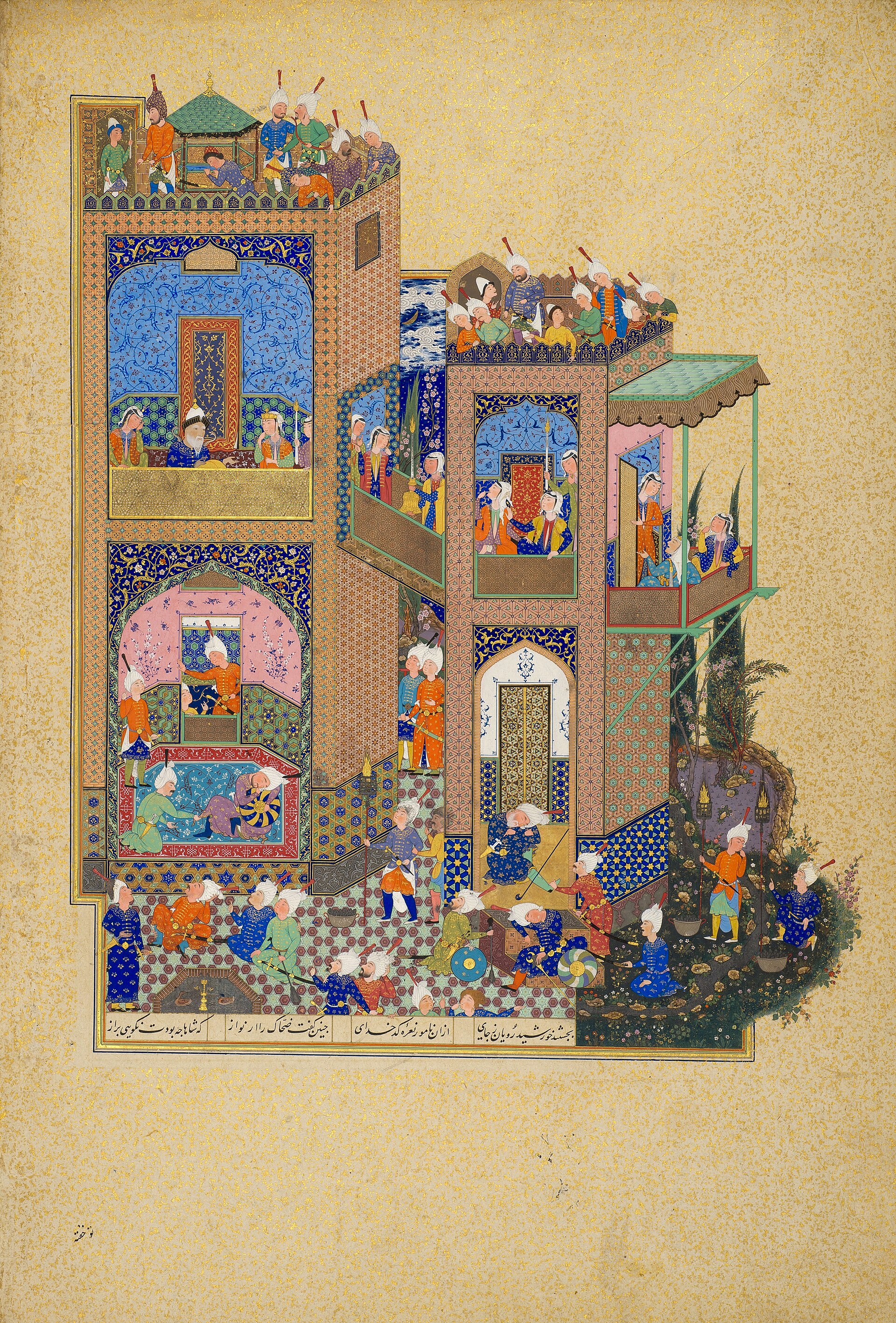
The serpent-shouldered tyrant dreams of Fereydūn, the one who will chain him. By Mir Musavvir, Tabriz.
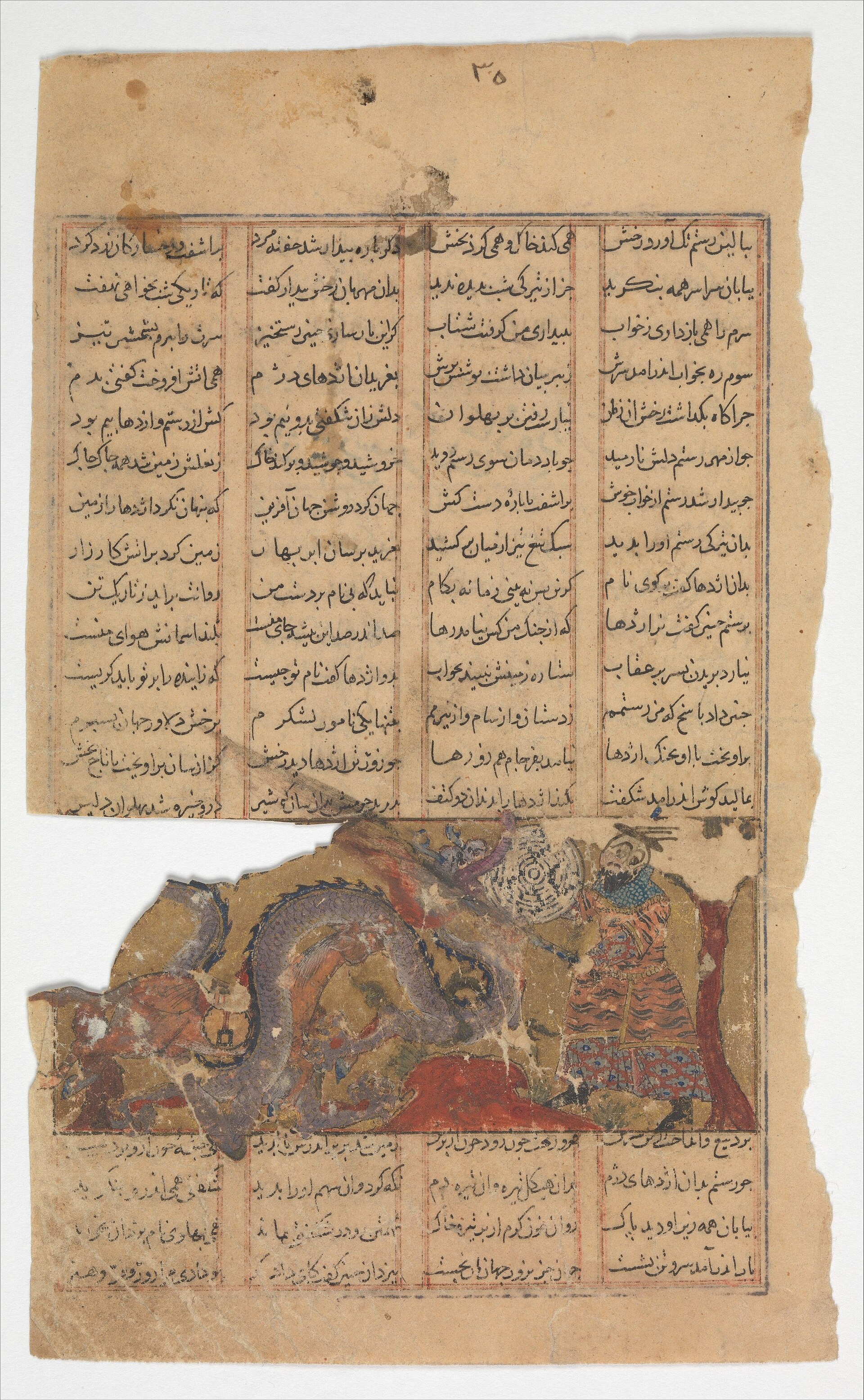
The third of the seven labours: hero, horse, and azhdahā locked together while Rakhsh bites the serpent's back.
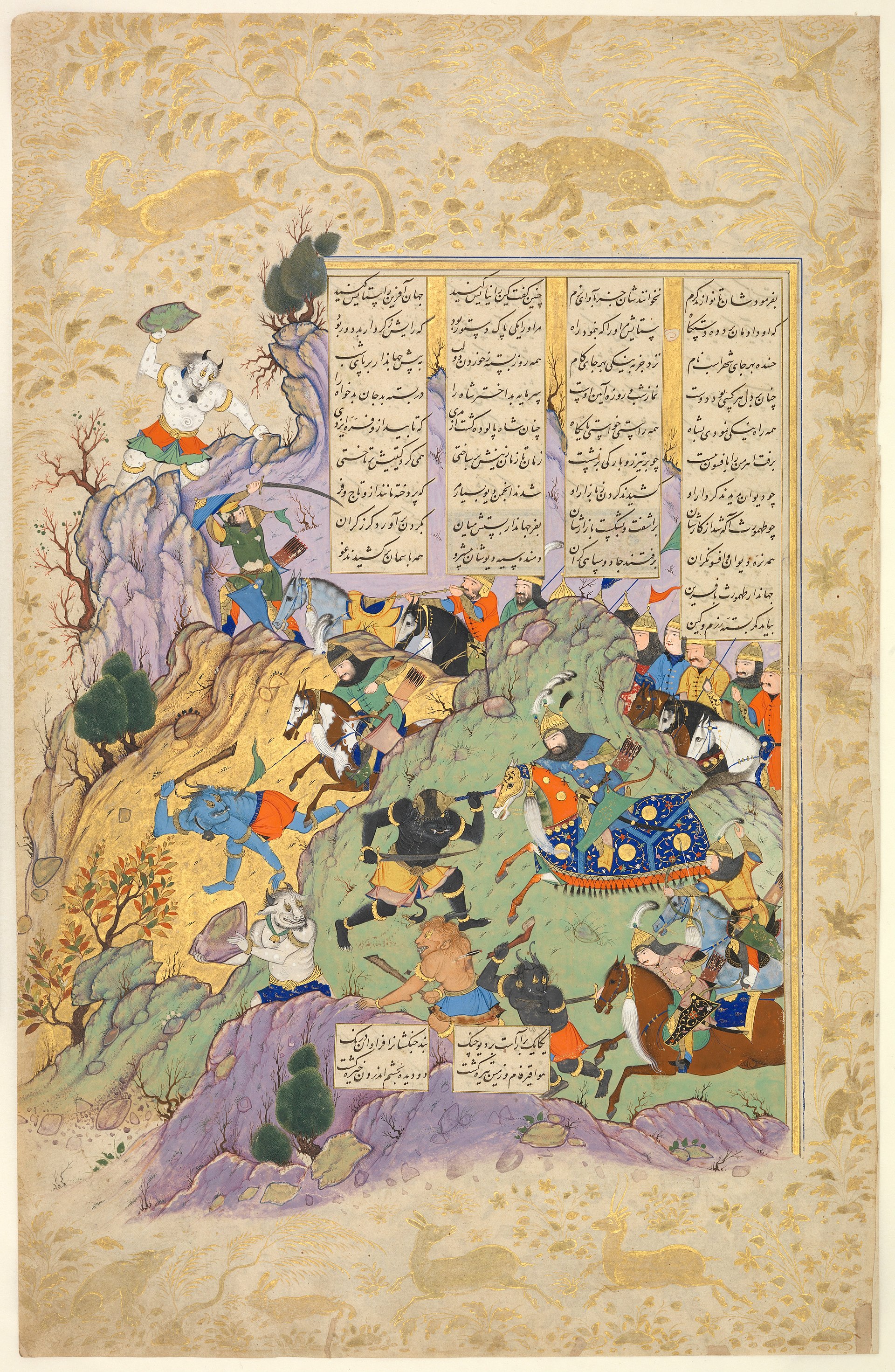
The demon-binder rides down the horned host of Mazandaran. Attributed to Reza Abbasi.