The body of revelation given to Zarathushtra and preserved in Avestan, a tongue so old it died as a spoken language before the Achaemenids and survived only as liturgy — memorised, syllable for syllable, for a hundred generations. The texts below are given in scholarly transliteration of the Avestan, the authoritative reading; the script above each is the sacred Din Dabireh hand.
The Four Great Manthras
These are spells in the oldest sense — sound the prophet himself called weapons against the Lie. The Order opens and closes every gathering with them.
Ahuna Vairya · “Yaθā Ahū Vairyō” — the seed-mantra of creation, holiest of all
“As the Lord is to be chosen, so is the Judge, by reason of Asha. The gift of Good Mind is for the deeds done for Mazda in this world; and power is given to Ahura, whom men set as shepherd to the poor.”
“I profess myself a worshipper of Mazda, a follower of Zarathushtra, opposed to the daēvas, holding the Lord’s doctrine — I praise and I choose the Good Thought, I praise and choose the Good Word, I praise and choose the Good Deed.”
From the Gāθās — the prophet’s own voice
Seventeen hymns within the Yasna, composed by Zarathushtra himself in metres older than Homer. Here he stands at the beginning of the world and asks the questions the Order still asks.
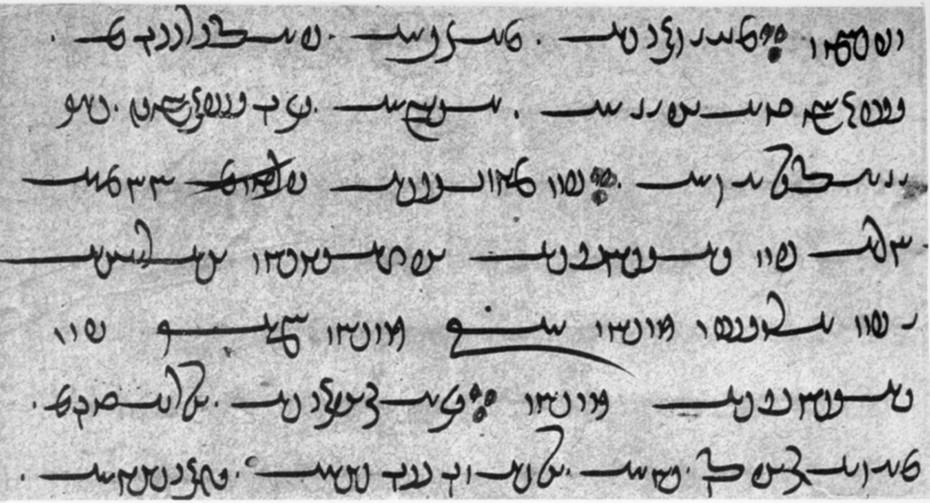
The Word Itself · Bodleian MS J2
Folio 175 of one of the oldest surviving books of the Avesta — copied in 1323 of the Common Era by the scribe Mihrabān Kaykhusraw, and opened at the very verse transliterated below: Yasna 28.1, the first breath of the Gāθās. Every letter of this hand was devised to fix a single sound the priests had carried in the mouth, unbroken, for two thousand years before a reed was ever set to the page.
Yasna 28.1 — the first words of the Gathas, the verse on the folio above
“With hands outstretched in reverence I beseech you, Mazda — first of all, the support of your Bounteous Spirit; that I may act through Asha in all things, and gain the wisdom of the Good Mind, and so content the Soul of Creation.”
Yasna 30.3 — the two primal spirits, the root of our ethics
“In the beginning the two Spirits, the twins, made themselves known — the Better and the Bad, in thought, in word, in deed. Between them the wise chose rightly; the foolish did not.”
The Two Ages of the Tongue
The Avesta is not one book but two languages, separated by perhaps a thousand years — as Chaucer's English stands from our own, but wider still. Both are called Avestan; only the older was ever truly spoken by those who shaped it.
Old Avestan · the Gathic
The archaic core: the seventeen Gāθās, the prose Yasna Haptaŋhāiti (“the Worship of Seven Chapters”), and the four great manthras. Its grammar is the twin of Vedic Sanskrit, set in the second millennium before our era — the unmediated speech of Zarathushtra and his first circle.
Younger Avestan · the liturgy
The vast remainder — the Yašts, the Vendidad, most of the Yasna, the Visperad, the Khordeh Avesta — composed over the centuries that followed, when the old tongue was already a sacred language learned by priests rather than spoken in the street. Around the ancient core the whole edifice of worship was raised.
So old is the Gathic layer that its priests preserved sounds they no longer understood — and in that fidelity, unwitting, they kept the words exact.
The shape of the book
What survives is a fragment — perhaps a quarter of the corpus burned in the conquests. The Order guards what remains.
Yasna
The 72 chapters of the chief liturgy, recited over the sacred haoma. At its heart sit the Gāθās. The 72 threads of the kushti cord we wear are counted from it.
Visperad
“All the Patrons” — supplements to the Yasna for the high seasonal feasts, the Gāhānbārs.
Yašts
Twenty-one hymns to the Yazatas — Mithra, Anāhitā, Tištrya, Vərəθraγna. The oldest mythology of Iran is here.
Vendidad
Vī-daēvō-dāta, “the law against the demons” — purity, contagion, and the war on pollution, recited only in the deep of night.
Khordeh Avesta
The “Little Avesta” — the book of daily prayer carried by every layperson: the Niyāyišns and the five Gāhs of the day.
The Lost Nasks
Of the original twenty-one Nasks, only one — the long Videvdad — survives entire; the rest are known now by their names and digests in the Pahlavi books alone. We mourn them at every fire.
The Keeping of the Word
No Zoroastrian read the Avesta for most of its life. It was recited — held in the trained memory of the priesthood and passed mouth to ear across a hundred generations, for a written scripture was thought less holy than a living one.
The Living Memory
For more than a thousand years the corpus existed only as sound. A mōbed learned it by heart in the priestly schools, each accent and pause a discipline; to misspeak a manthra was to blunt its edge against the Lie.
The Invented Alphabet
Only under the Sasanians, around the sixth century CE, did the priests forge a script equal to the task — the Din Dabireh, “the religion-writing,” of some fifty-three letters built to catch every vowel and breath the older scripts had blurred. It is the hand you see across this page.
The Great Loss
When the temples and their libraries fell in the seventh century, the written Great Avesta was scattered and burned. What endured was the liturgy the priests still carried by heart — saved because it was sung, not because it was shelved.
The Fire in Silver
Before the Word was ever written it was already stamped in metal. On the coinage of Iran the fire-altar became the face of the faith — the one emblem a king could press into every hand in his realm.
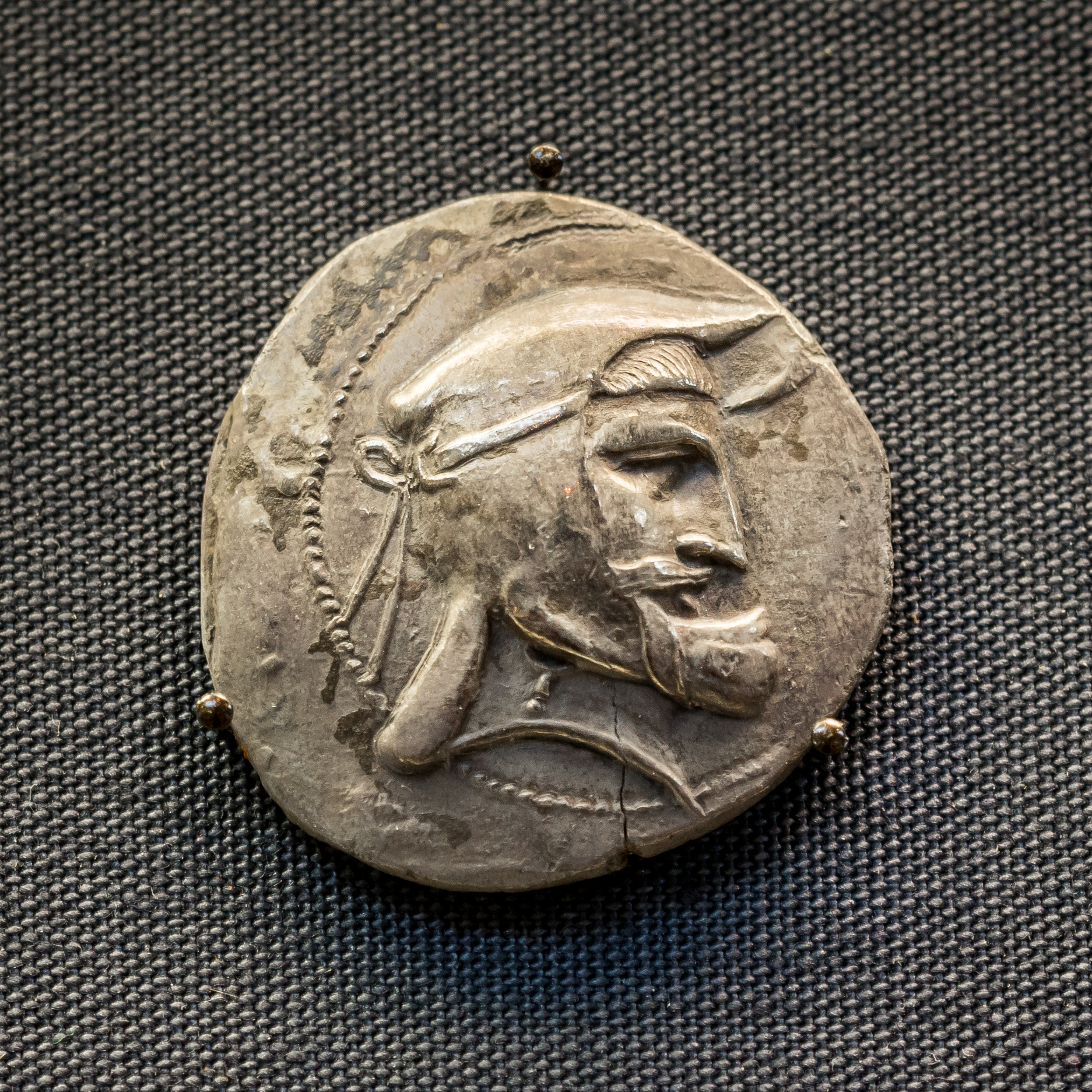
Persis · c. 3rd–2nd century BCE
The Coin of Vadfradad
Struck by the Frataraka — priest-kings who ruled the Persian homeland after Alexander — this silver shows the lord standing in worship before a fire-temple and standard, a winged figure hovering above. It is among the earliest images of Zoroastrian worship ever set on money.
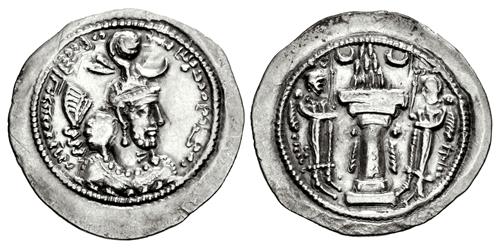
Sasanian Iran · 399–420 CE
The Drachm of Yazdgird I
For four centuries the Sasanian drachm carried one unchanging reverse: the sacred fire blazing on its altar, flanked by two attendant priests. The fire of the realm, the ātaš itself, had become the seal of the state — Mazdā-worship made into coin of the realm.
The Royal Script
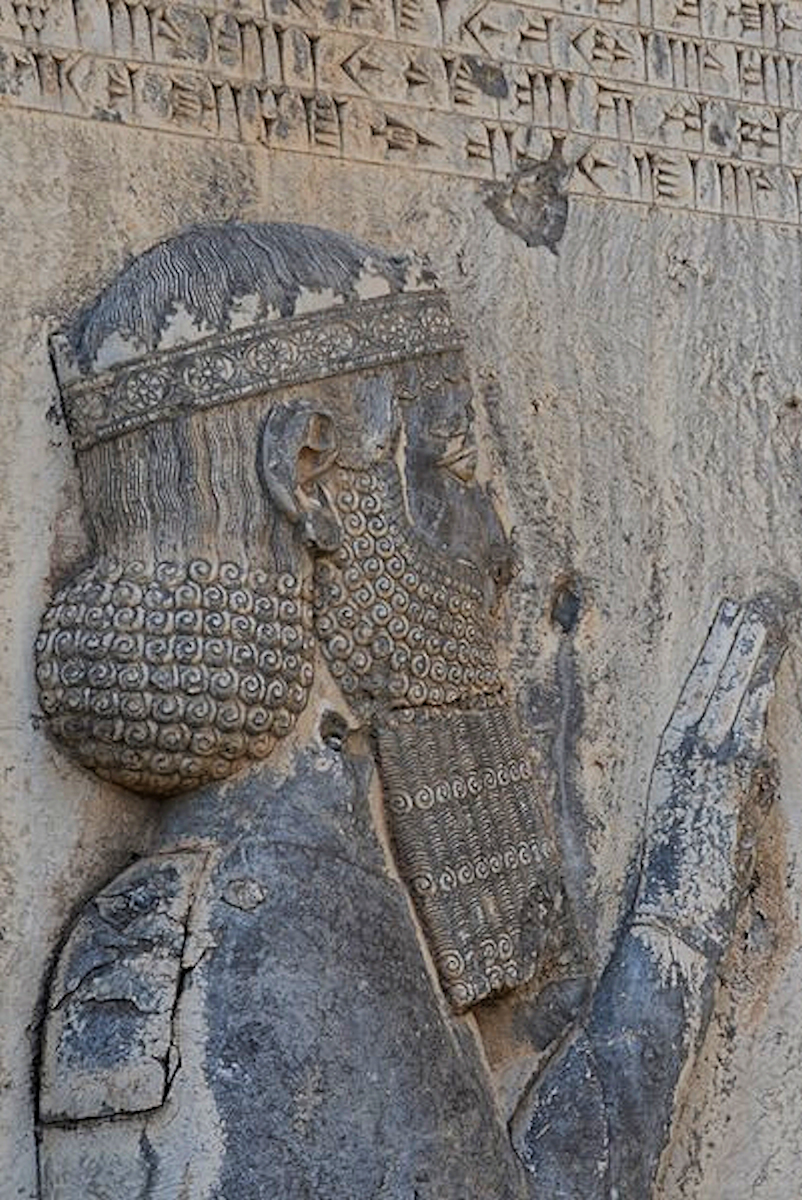
Beside the sacred Avestan hand there is the royal script — Old Persian cuneiform, devised under Darius the Great to carve the will of kings into living rock. It is a simple syllabary of thirty-six signs, read left to right, each word closed by a slanting wedge. Where Avestan whispers the liturgy, cuneiform proclaims the empire.
High on a cliff in Kermanshah, Darius cut his victory in three tongues — Old Persian, Elamite, and Babylonian — the trilingual key that unlocked cuneiform for the modern world.
DNa, the tomb of Darius the Great at Naqsh-e Rostam (c. 490 BCE) — §1, the royal confession of Ahura Mazda
“A great god is Ahura Mazda, who created this earth, who created yonder sky, who created mankind, who created happiness for mankind, who made Darius king.”
Switch the tongue, top-right, to 𐎠𐎼 and the whole Order speaks in this royal hand.